
By C.
For those familiar with the electric guitar, you’ve certainly heard the term “humbucker” in regards to pickups. These double-coil pickups differ greatly from their single-coil ancestors in both sound and aesthetics. These days, there is a wide variety of humbuckers available for practically any purpose. But what are the original humbuckers to rule them all? That would be the Gibson ‘PAF’, of course!
Do you have a vintage guitar or bass you’d like to sell? Contact us here
The Gibson PAF (Patent Applied For) humbucker is one of the most iconic and influential guitar pickups in the history of electric guitar design. Developed by Gibson’s legendary engineer Seth Lover in the mid-1950s, the PAF humbucker revolutionized the sound of the electric guitar, offering a new level of clarity, warmth, and tonal richness that was a radical departure from the earlier single-coil pickups. While its original production lasted only a few years, the PAF humbucker’s sound has continued to define the tone of vintage electric guitars, particularly Gibson’s famous models like the Les Paul, L-5, ES-335, and SG.

Before the PAF humbucker, single-coil pickups like the ones used by Fender in their Stratocaster and Telecaster guitars dominated the electric guitar world. While these pickups had a bright and articulate sound, they were also prone to a common problem: 60-cycle hum, a type of noise interference caused by electromagnetic fields from power sources and other equipment. Seth Lover’s goal was to design a pickup that could eliminate this hum while maintaining high output and tonal quality.
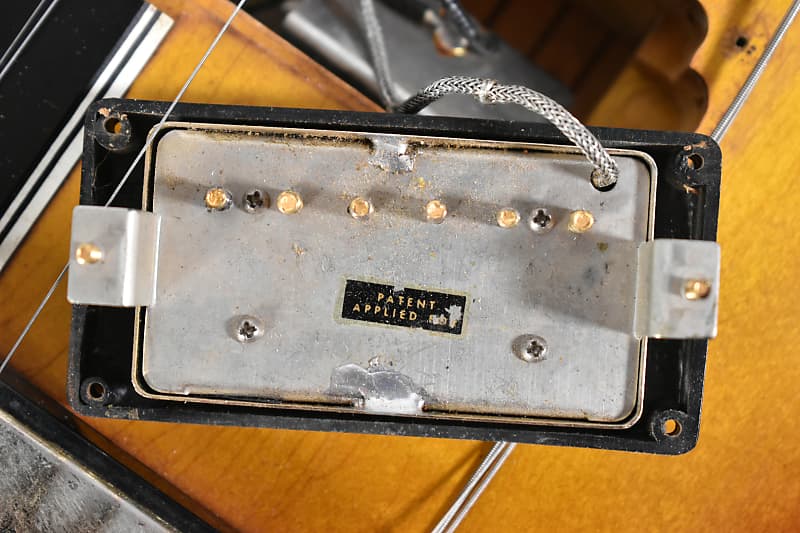
In 1955, Gibson applied for a patent on Lover’s humbucker design, but the patent wasn’t granted until 1959. But in 1957, Gibson began producing the pickups with stickers that read “Patent Applied For,” giving the PAF its iconic name. These pickups were first introduced on archtop models like the ES-175, L-5 as well as solidbody models such as the Les Paul Standard and Custom. The PAF quickly became a critical part of Gibson’s sound and is now regarded as a cornerstone of the “golden era” of electric guitars.

Now for some tech-specs. The PAF is a dual-coil humbucker, meaning it consists of two coils of wire wound around magnets. Each coil is wound in opposite directions, and the magnets are polarized in opposite directions. This design effectively cancels out the hum that plagues single-coil pickups, while still allowing the guitar’s string vibrations to generate sound. This concept is called “humbucking,” hence the name humbucker.
The PAF typically used Alnico II, IV, or V magnets (depending on the year and model), and it was wound with 42-gauge enamel-coated copper wire. One of the defining characteristics of original PAFs is their inconsistency in terms of output. During production in the late 1950s, the winding machines were not always calibrated for exact precision, so some PAFs had more winds of wire than others, leading to variations in output and tone from pickup to pickup. This lack of uniformity is one reason why vintage PAFs are so highly sought after—each one has its own unique sound.
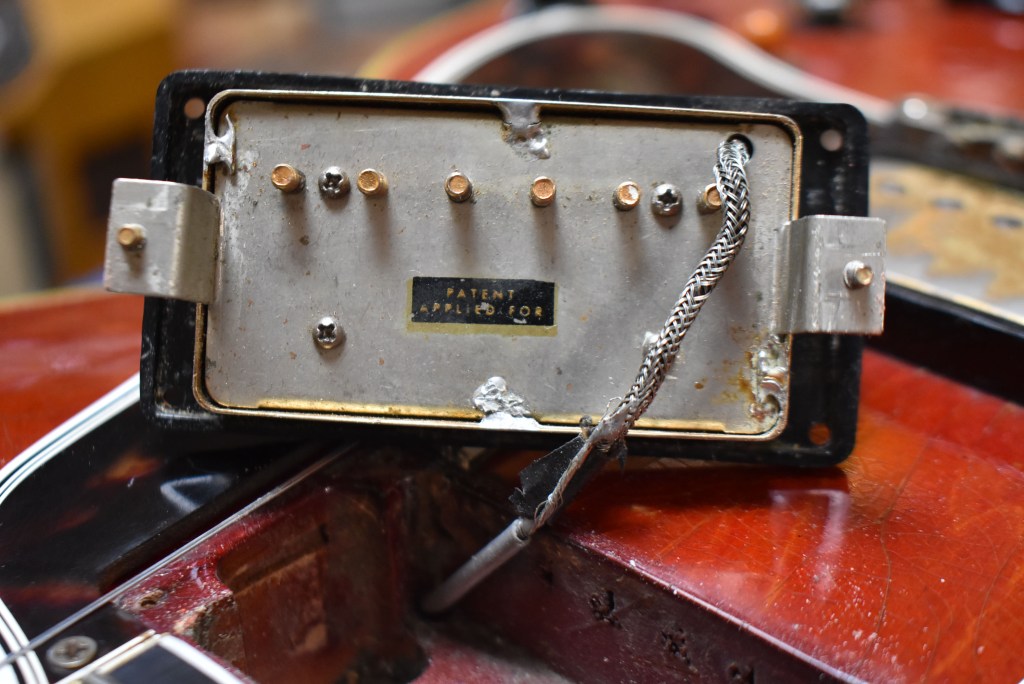
The average PAF has an output of between 7.5k and 8.5k ohms, which is relatively moderate by today’s standards. This modest output is key to its characteristic tone: a warm, smooth sound with a natural compression, but without the aggressive output of modern high-gain pickups. The result is a pickup that responds well to dynamics, allowing guitarists to achieve everything from clean, bell-like tones to rich, overdriven sustain.
Did you know we also buy collections? If you need to sell multiple pieces at once quickly and easily, send us an email or give us a call for more info
Another key trait of the PAF humbucker is its versatility. Unlike many modern pickups that are designed for specific genres or tones, the PAF can cover a broad range of sounds. Its tonal profile is often described as warm, balanced, and articulate, with a strong midrange and smooth high-end response. This makes it ideal for a wide variety of musical styles, from jazz and blues to hard rock and even early forms of metal.
When played clean, the PAF humbucker delivers a round, full-bodied tone with clarity and note separation. It doesn’t exhibit the spikiness or treble-heavy response of single-coils but instead offers a more even frequency response. When overdriven, the PAF shines with creamy sustain and harmonic richness, making it a favorite for classic rock tones. Its midrange emphasis also allows it to cut through a mix without being overly harsh or boomy.
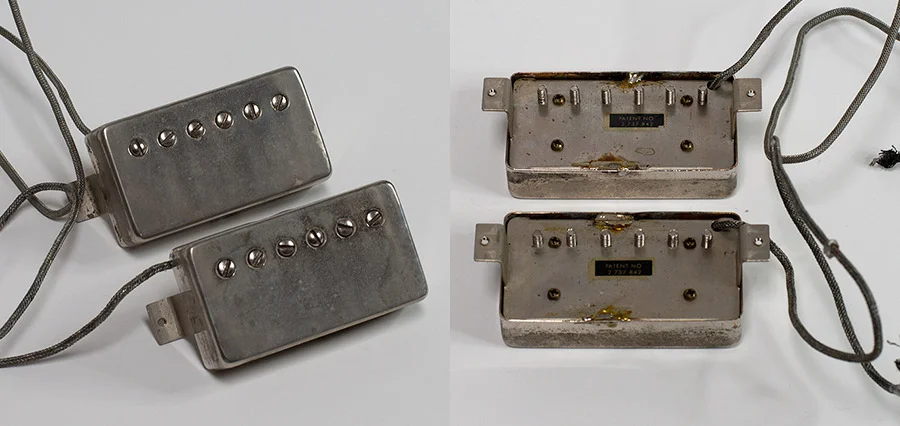
Though the original PAF pickups were discontinued in the early 1960s, their reputation has only grown over time. Today, vintage PAFs are among the most sought-after components in the world of guitars, with collectors and players paying thousands of dollars for original examples. Many modern guitarists who can’t afford vintage PAFs look to reproductions and reissues that attempt to capture the magic of the original design. And while some come close, there’s just nothing quite like the real thing.
Gibson themselves have released several reissues of the PAF over the years, including the Burstbucker and ’57 Classic series. Other companies, such as Seymour Duncan and DiMarzio, also produce PAF-style pickups, each offering slight variations on the original design. These modern recreations aim to offer guitarists the same tonal characteristics that made the PAF legendary, often incorporating modern manufacturing techniques for greater consistency while maintaining the vintage sound.

The PAF humbucker’s influence on electric guitar tone cannot be overstated. The sound has been heard on countless recordings and has influenced musicians for over half a century. Its combination of hum-canceling functionality, dynamic range, and warmth has made it a staple in the electric guitar world for over six decades, and its legacy shows no sign of fading. Whether in its original form or through countless reissues, the PAF remains a defining feature of some of the most iconic guitars and guitarists in history.
With 4 stores across Southern California, we’re always buying! Not sure what your instrument is worth? Bring it by the shop or schedule an appraisal online
 IVG Blog