

By C.
When it comes to guitarists, most people prefer to have an arsenal of different instruments to suit their needs on-stage or in the studio. The right tool for the right job, as they say. Many of the same models tend to get the most praise time and time again, but what are some other alternatives? Today we’ll be examining a guitar that you may (or may not) have heard of. These guitars remain beloved by those that own and collect them, as well as newcomers who are often surprised by their unexpected playability, quality, sound and price point. So let’s take a closer look at… the Guild Starfire !
Do you have a vintage guitar or bass you’d like to sell? Contact us here
The Guild Starfire is one of the most iconic electric guitars produced by Guild, a renowned American guitar manufacturer established in 1952. Starfires have been around for quite a while. First introduced in the early 1960s, the line became popular due to its versatility, stylish design, and rich, warm tones, making it a favorite of many musicians across a variety of genres, including rock, blues, and jazz. Its appeal has lasted for decades, with both vintage models and modern reissues continuing to capture the attention of players.
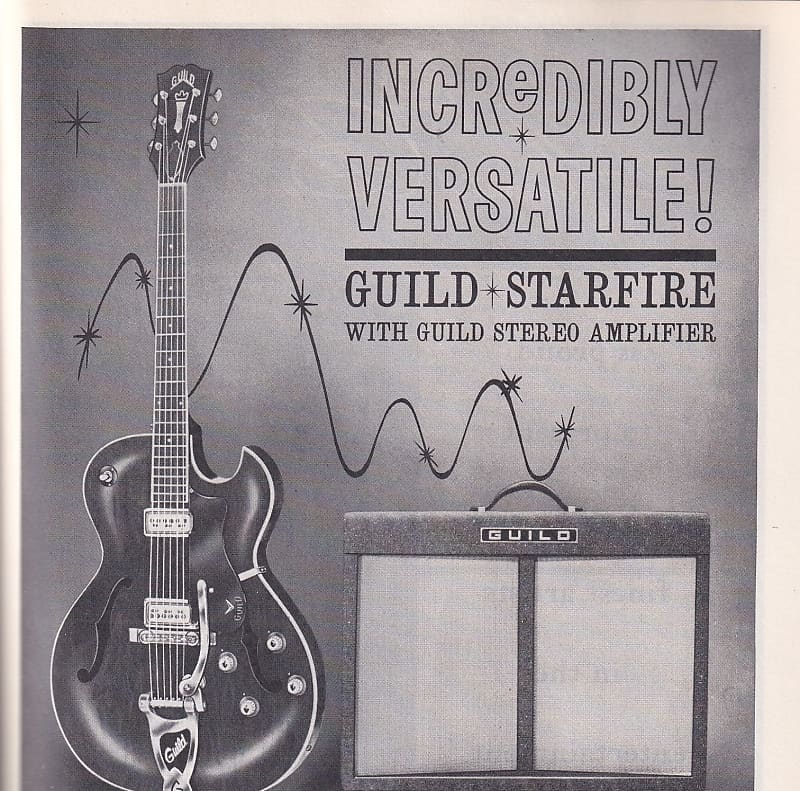
Guild introduced the Starfire in 1960, during a time when semi-hollow body guitars were growing in popularity. Gibson’s ES-335, introduced in 1958, had already made waves, and the Starfire represented Guild’s entry into this emerging market. What set the Starfire apart from other models was its unique combination of design, craftsmanship, and sonic character. Early models of the Starfire were relatively simple, but over time, Guild introduced several variations and improvements to spice things up.
There are several key models in the Starfire series, each with its distinct characteristics. The Starfire I, or the original version. First introduced in 1960, the Starfire I featured a thin, fully-hollow body with a single Florentine cutaway, allowing easy access to higher frets. It had a single DeArmond pickup and was aimed at jazz and blues musicians. The body was typically made from maple, giving it a bright, resonant sound.
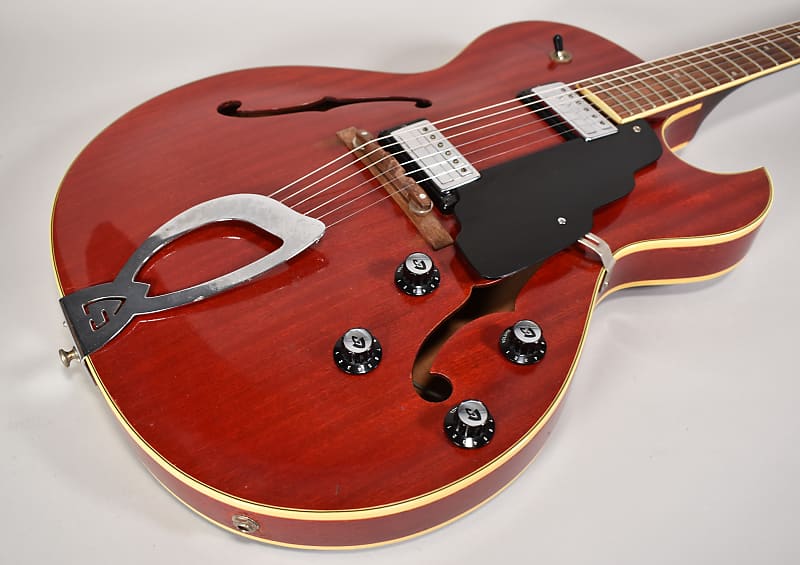
Then came the Starfire II and III, with the Starfire II having two pickups and the Starfire III featuring a Bigsby tremolo for added versatility. Both offered more tonal options, allowing players to move between warm, mellow tones and brighter, more aggressive sounds.
Onto the Starfire IV, V, and VI’s. As the series evolved, Guild introduced double-cutaway models in the mid-1960s, which further expanded the guitar’s appeal to rock and blues players. The Starfire IV became particularly popular in rock music due to its ability to handle higher levels of distortion while maintaining clarity. The Starfire V and VI models were even more luxurious, with features such as flame maple tops, ebony fingerboards and decorative block inlays.
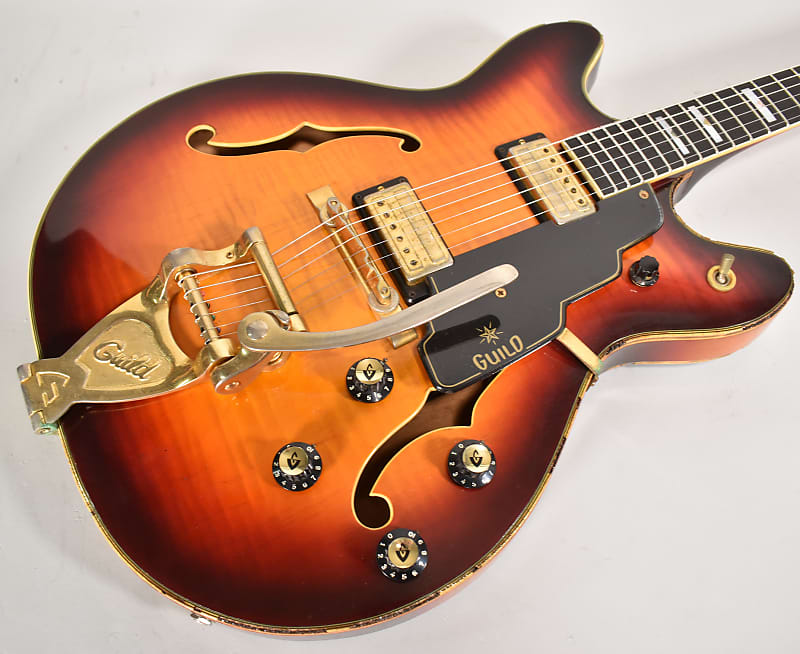
One of the defining features of the Starfire IV, V, and Vi’s is their semi-hollow body construction. Semi-hollow body guitars, unlike solid-body guitars, have chambers inside the body that help create a unique resonance, giving the guitar a more open, warm sound. This made the guitars especially well-suited for genres like jazz and blues, where smooth, rounded tones are often desired. However, its ability to handle higher gain without excessive feedback also made it a favorite in rock and even punk genres.
Did you know we also buy collections? If you need to sell multiple pieces at once quickly and easily, send us an email or give us a call for more info
The Starfire’s pickups also play a crucial role in its tone. Early models featured single-coil pickups by DeArmond, but later versions incorporated Guild’s signature humbuckers, known for their warm, fat tones. These pickups can produce a range of sounds, from clean and jazzy to gritty and overdriven. The controls (typically a three-way pickup selector, volume, and tone knobs) allow for fine adjustments to the sound, giving the player substantial flexibility.

Over the years, the Guild Starfire has found its way into the hands of many influential musicians. One of the most famous users of the Starfire is Jerry Garcia of the Grateful Dead, who played a Starfire III early in his career. The guitar’s subtle, articulate tone complemented Garcia’s fluid, exploratory playing style, making it an integral part of the Dead’s early sound.
Other notable players include Buddy Guy, Elvis Costello, Tom Fogerty of Creedence Clearwater Revival, and John Lennon, who used a Guild Starfire 12-String during his time with The Beatles. Each of these artists appreciated the guitar’s blend of classic semi-hollow tone and modern playability.
Guild’s Starfire guitars have remained relevant throughout the decades. Vintage models from the 1960s and 1970s are now sought after by collectors, but the brand has also introduced modern reissues that capture the spirit of the originals while incorporating contemporary improvements. Guild’s Starfire IV, V, and VI reissues feature updated hardware and electronics, and reliable construction, ensuring that they meet the needs of modern players while staying true to their 60’s heritage.
Today, the Starfire is celebrated for its versatility, offering players a wide palette of tones, from smooth jazz chords to biting rock riffs. Its distinctive looks, especially the double-cutaway models with their elegant curves, make it a visually striking instrument as well.
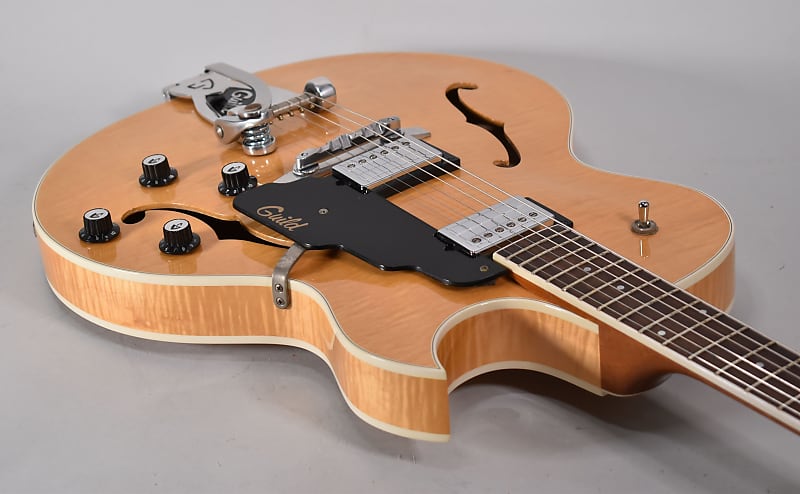
The Guild Starfire remains an iconic guitar that has stood the test of time. The Starfire’s combination of hollow and semi-hollow body tone, versatility, and historical significance has made it a hidden-gem of an instrument to many players throughout the decades. If you’re a blues player seeking rich, mellow tones, a rock guitarist pushing the boundaries of distortion, or a jazz musician in search of clarity and articulation, there’s a Starfire out there that may be just the right ingredient for your sound.
With 4 stores across Southern California, we’re always buying! Not sure what your instrument is worth? Bring it by the shop or schedule an appraisal online
 IVG Blog