

By C.
Effects pedals are a mainstay in many musicians rigs. Players today have almost infinite options of preamp pedals, distortions, overdrives, and fuzzes to choose from to sculpt their sound. But believe it or not, there was a time when there weren’t many pedal options available at all. The original Big Muff Pi is a product of this era, and if you’re not familiar, its an iconic guitar effects pedal with a rich history that spans over five decades. It has been an essential tool for guitarists seeking to add distinctive, heavy distortion to their sound. Renowned for its smooth sustain, rich harmonic overtones, and versatile tonal range, the Big Muff has influenced countless musicians across genres, from rock to punk to alternative. Today we’ll be taking a look at this lovely 1969 Electro-Harmonix Big Muff Pi V1 Triangle, currently for sale here at IVG.
Do you have a vintage guitar or bass you’d like to sell? Contact us here
The Big Muff’s story begins in the late 1960s, a period of significant innovation in the world of electric guitar effects. During this time, engineers and musicians were experimenting with ways to manipulate the electric guitar’s sound, leading to the development of various distortion and fuzz pedals. One of the key figures in this movement was Mike Matthews, an electrical engineer and entrepreneur who had a deep love for music.

In 1968, Matthews founded Electro-Harmonix, a company that would go on to become one of the most influential manufacturers of guitar effects pedals. The first major product that Matthews released was the LPB-1 (Linear Power Booster), a simple yet powerful pedal that boosted a guitar’s signal, leading to a more pronounced and distorted tone when used with an amplifier.
Encouraged by the success of the LPB-1, Matthews began developing a more complex distortion pedal that would offer a richer, smoother sound. In collaboration with Bob Myer, an audio engineer who had previously worked with Bell Laboratories, Matthews set out to create a pedal that would stand out in a market increasingly saturated with fuzz effects.
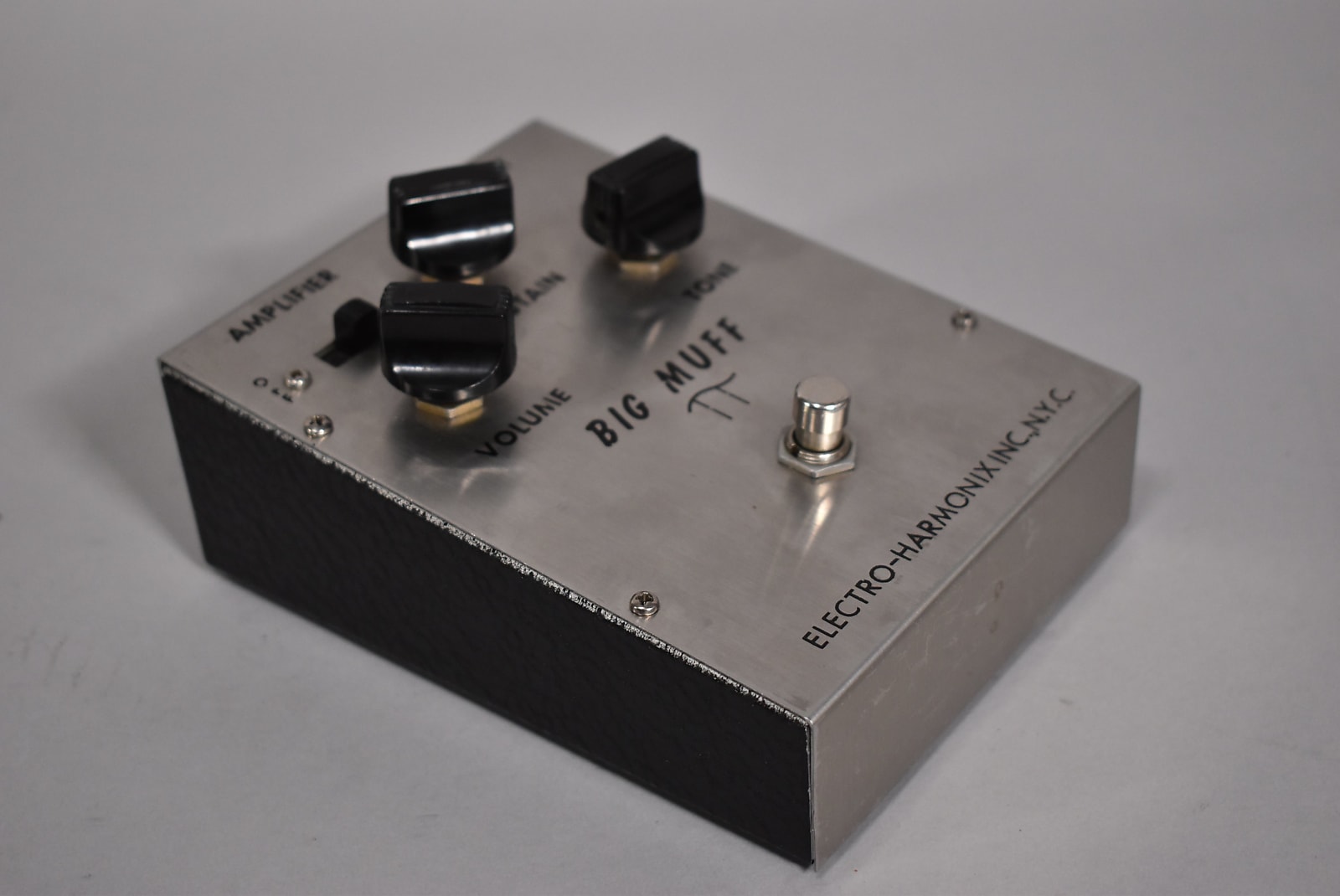
The result was the Big Muff Pi, which debuted in 1969. The pedal was a relative success, thanks in large part to its unique sound. Unlike other fuzz pedals of the time, which often produced a buzzy, erratic sound, the Big Muff offered a wide range of sounds from harsh, abrasive distortion, to a smoother, more musical tone with a rich sustain. This made it particularly appealing to guitarists looking to emulate the soaring, sustaining leads of artists like Jimi Hendrix, who used a Dallas-Arbiter Fuzz Face throughout most of his career.
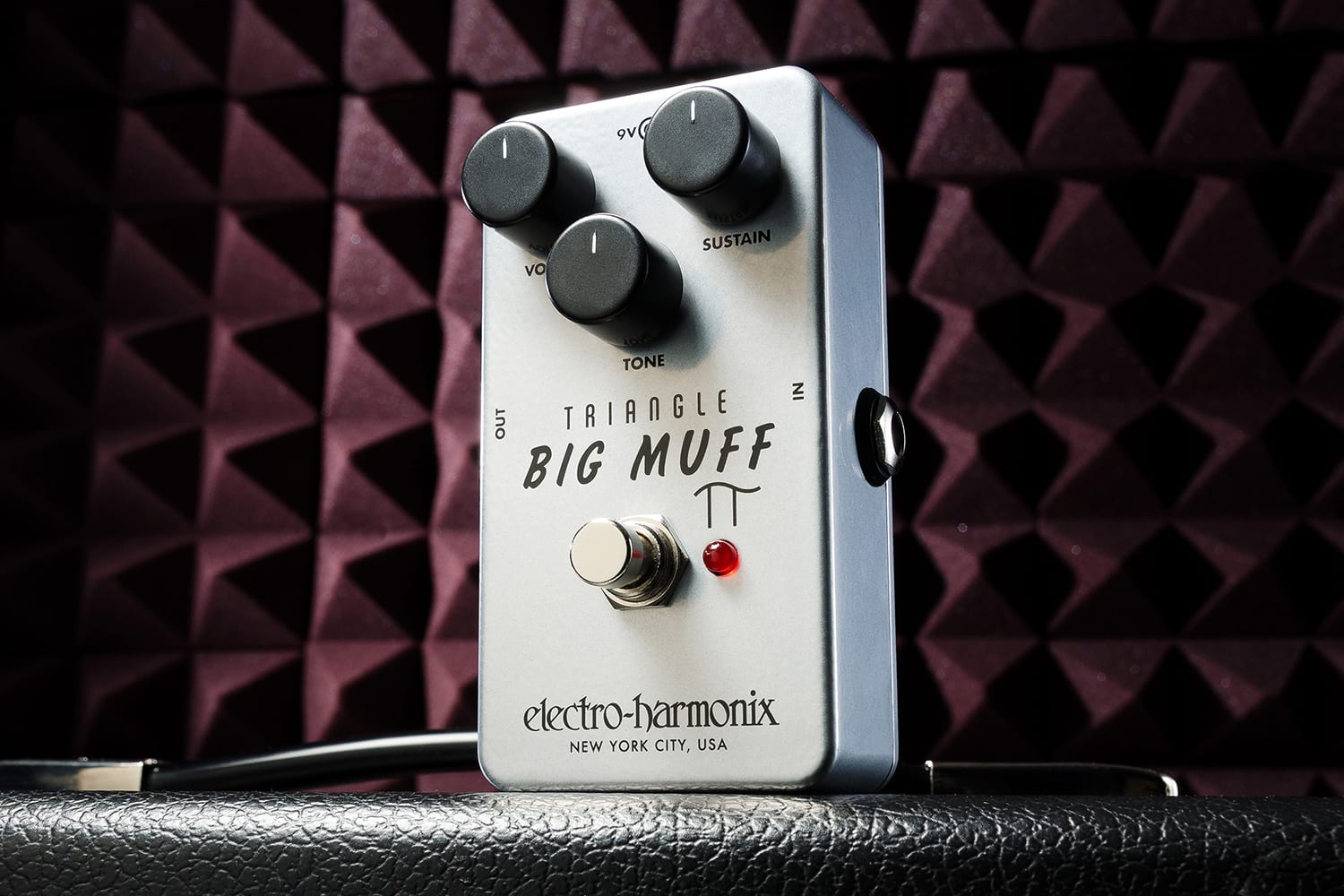
Throughout the 1970s and 1980s, the Big Muff underwent several changes in design and construction, leading to a variety of different versions of the pedal. This is an example of the original Big Muff Pi, known today as the “Triangle” version due to the layout of its control knobs, which was followed by the “Ram’s Head” version in the early 1970s. The Triangle Big Muffs are regarded for their brighter and more aggressive sound, whereas the later Ram’s Head Big Muff is known for its smoother sound and slightly more pronounced midrange, making both a favorite for many players. It’s important to note, that the circuits in early Big Muffs varied in terms of the components used, which makes each one relatively unique. They don’t all sound exactly the same, and thats part of the triangle charm!
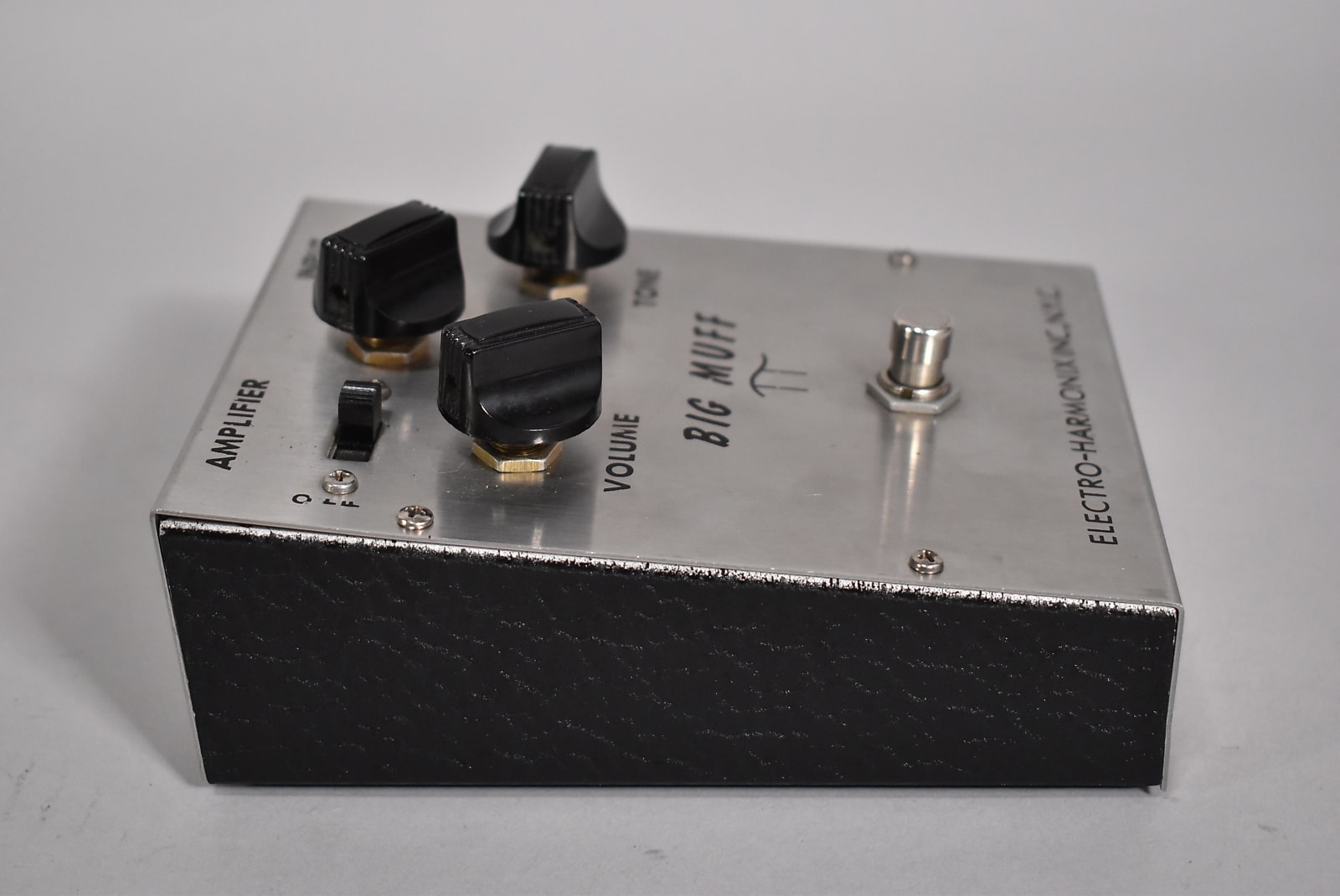
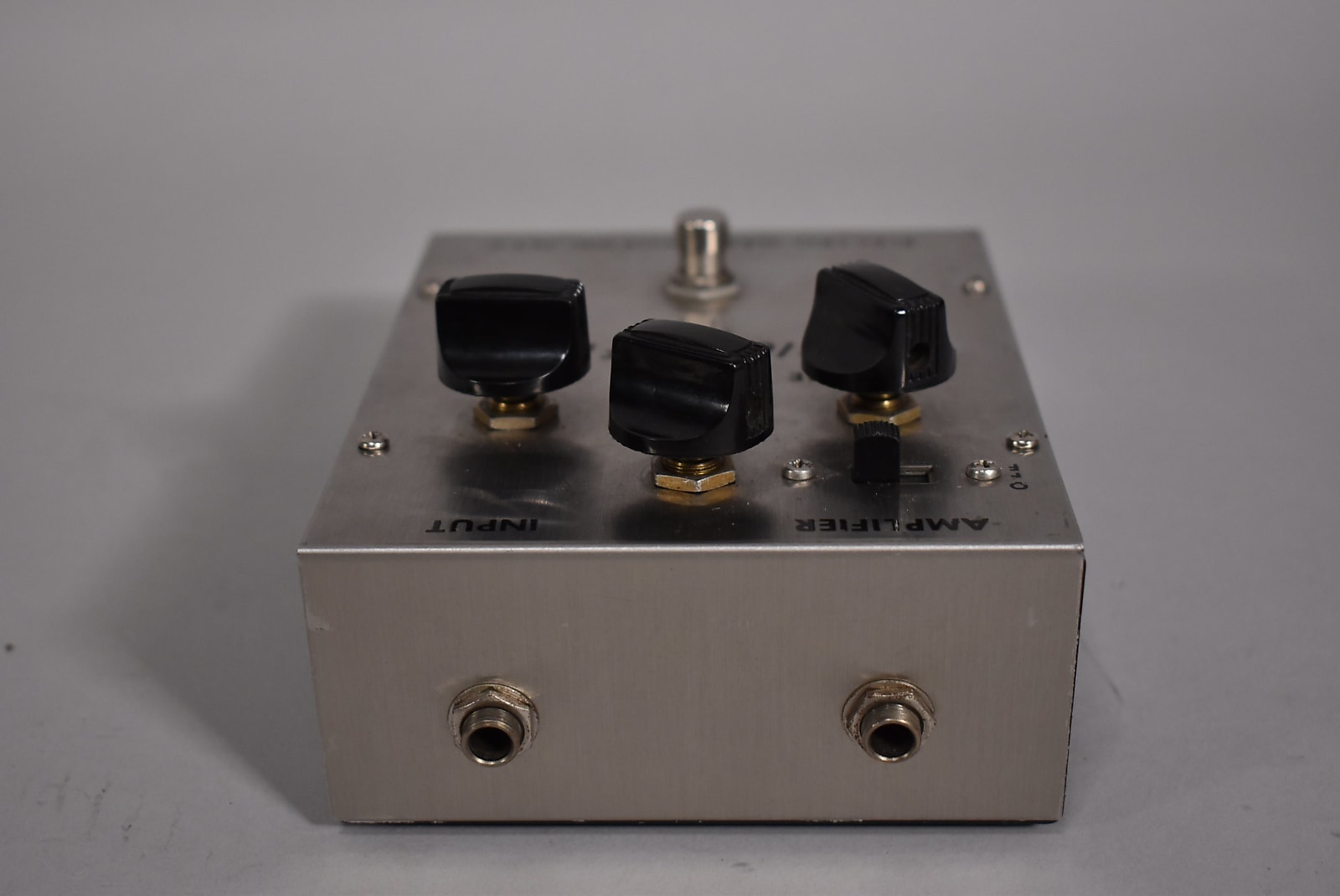
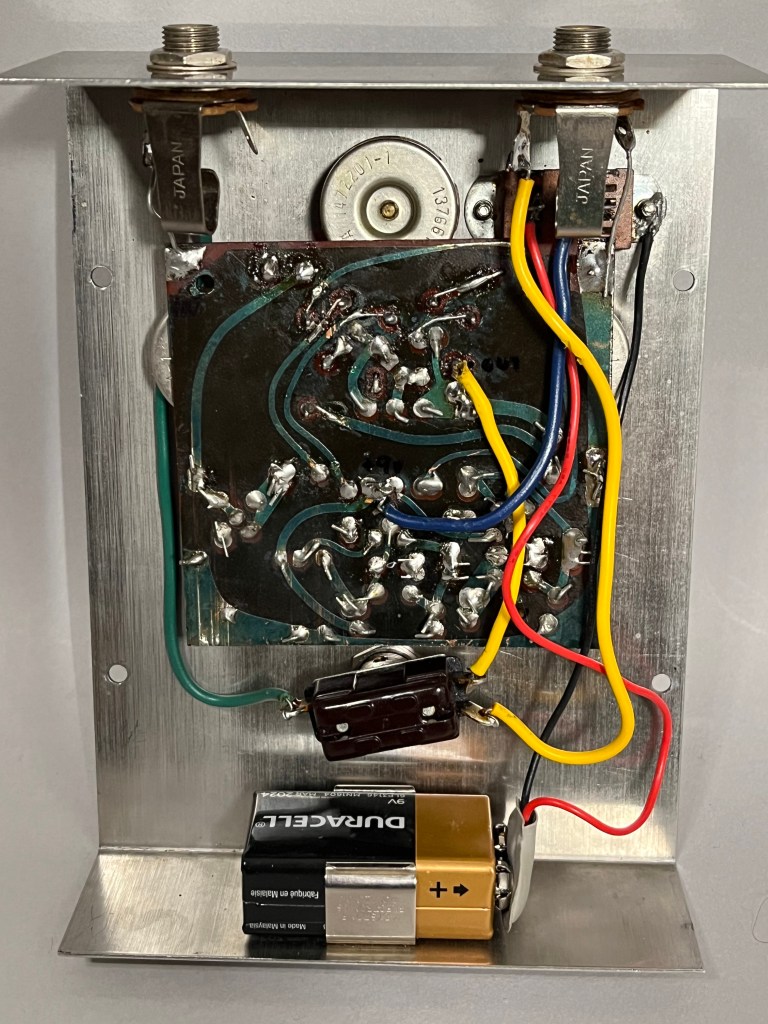
This one is essentially a collector grade, as many of these pedals saw rigorous use and will show much of the original printing worn away, heavy damage on the enclosure surface, and even replaced internal components such as pots, foot switch etc. Of course, the pedal is over 50 years old and does display some light cosmetic surface wear here and there, but it is fully-functional and all original, about as nice as it gets!
Did you know we also buy collections? If you need to sell multiple pieces at once quickly and easily, send us an email or give us a call for more info
Despite financial difficulties that led to the temporary closure of Electro-Harmonix in the early 1980s, the Big Muff’s popularity persisted. The pedal continued to be produced under different brands and in Russia, where a series of Big Muffs were manufactured under the Sovtek brand. These Russian-made Big Muffs, often housed in rugged, military-style enclosures, became known for their unique, bass-heavy sound and are still highly sought after by collectors and musicians.
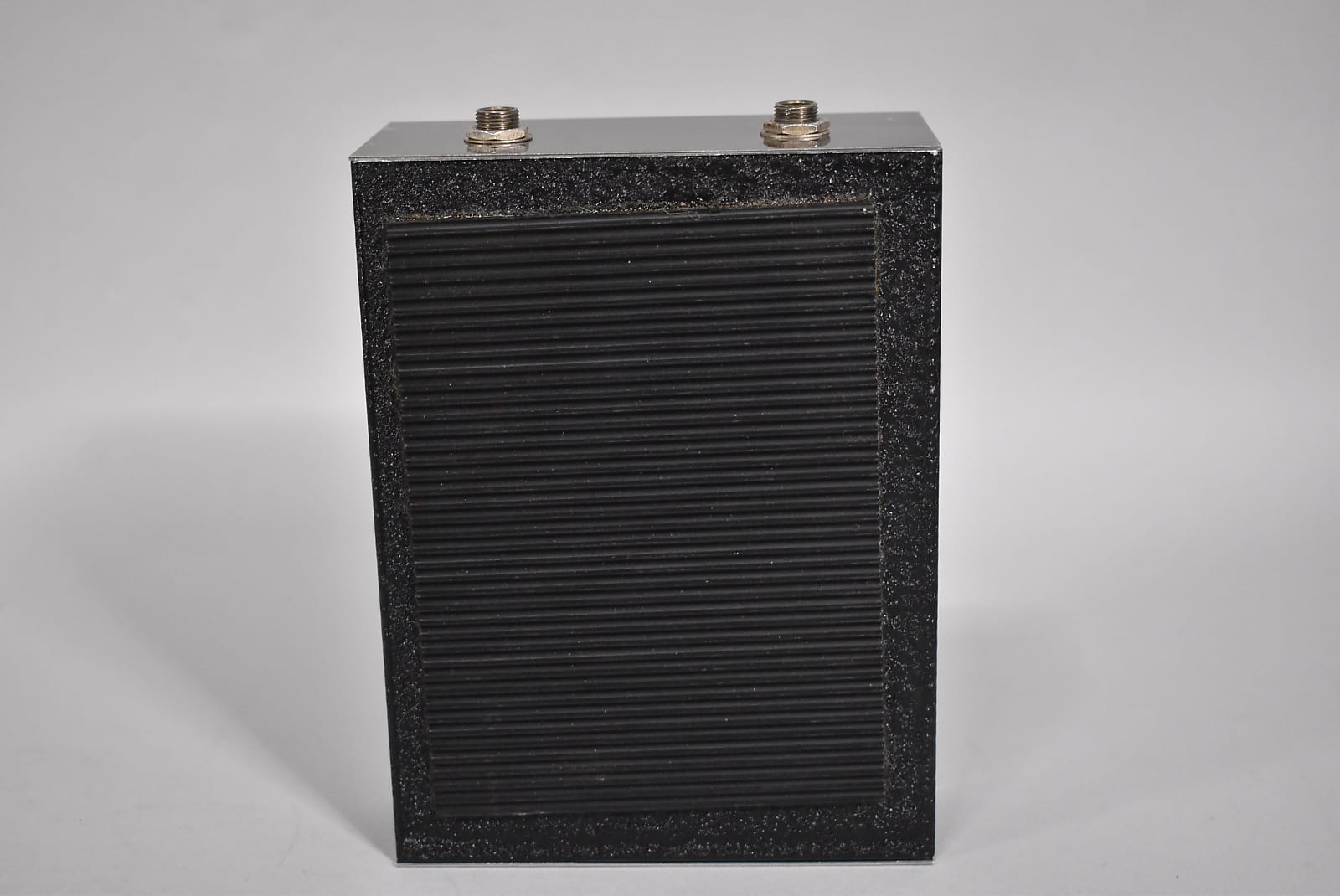
In the 1990s, Electro-Harmonix was revived, and with it, the Big Muff returned to prominence. The company began reissuing many of the classic Big Muff models, as well as introducing new versions of the pedal, such as the “Little Big Muff” and the “Bass Big Muff,” which were designed specifically for bass guitar. EHX recently offered the world a long-awaited reissue of the triangle circuit, pictured here.
Today, the Big Muff remains one of the most popular and enduring effects pedals in the world. Its influence can be heard in the music of countless artists, from David Gilmour of Pink Floyd to Jack White of The White Stripes. The pedal’s combination of rich distortion, smooth sustain, and versatile tone-shaping capabilities ensures that it will continue to be a staple in the arsenals of guitarists for generations to come. It’s hard to go wrong with any version of an original Big Muff, as each era has its strengths and unique tonal characteristics. This ’69 Muff is not only historically significant as an early version, but it sounds great too!
The Big Muff Pi gave birth to a unique sound that shaped the sound of many of our favorite artists, and continues to influence generations of musicians to define the sonic landscape of rock and beyond. New versions and reissues continue to emerge, and the Big Muff’s legacy as a groundbreaking tool for sonic exploration remains secure. And as a vintage dealer, we’re always pleased to see clean original versions of some of these legendary effects. So if you’re considering adding a rare first version Big Muff to your collection, now could be the time! You won’t be disappointed, just ask J Mascis..
With 4 stores across Southern California, we’re always buying! Not sure what your instrument is worth? Bring it by the shop or schedule an appraisal online
 IVG Blog