

By C.
The Gibson Flying V is one of those designs unlike anything else out there. It’s a guitar so iconic that you might even recognize it if you’re completely unfamiliar with guitars. The Flying V, or “V” for short, has made a powerful impact on the world of music since its introduction in the late 1950s. Known for its distinctive space-age V-shaped body, the Flying V has become synonymous with rock and metal genres, and its unique design continues to captivate guitarists and fans alike.
Do you have a vintage guitar you’d like to sell? Contact us here

Introduced by Gibson in 1958, the Flying V was part of the company’s futuristic series, which also included the Explorer and the Moderne (a model that never really made it to production until the 80’s). Designed by Ted McCarty, Gibson’s president at the time, the Flying V broke the mold of all traditional guitar shapes that came before it. Its sleek and angular design was ahead of its time, making it both revolutionary and polarizing for the 1950’s era. But take one look at a 50’s V and you can surely see why it was destined to become a holy grail guitar..
The Flying V’s body was originally crafted from solid korina, providing a resonant tone with plenty of mid-range. Korina is similar to mahogany, but was used primarily because it provided a lighter wood for the oversized body. The iconic V shape isn’t just about aesthetics; it also contributes to the guitar’s playability and overall sound. The neck (also made from Korina on 50’s examples) with a Brazilian rosewood fretboard and large profile, offered smooth playability and a comfortable feel for the guitarist despite the unusual shape.
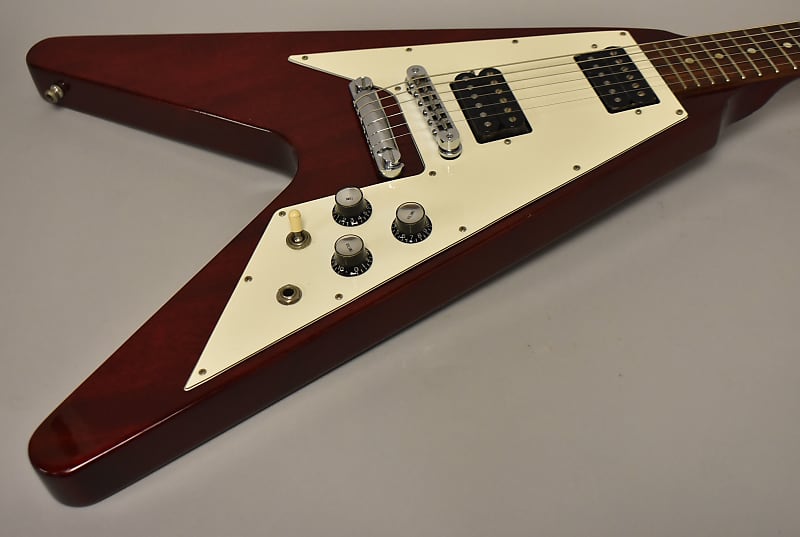
One of the key features of the Flying V is its dual humbucking pickups, known for delivering a powerful and noise-resistant signal. Since its birth year was 1958, the Flying V featured the newly implemented ‘PAFs’ that graced almost all Gibson electrics from 1957 -1961. These pickups contribute to the guitar’s ability to produce thick, creamy tones that are particularly well-suited for genres like blues, hard rock, and metal. The Flying V’s electronic setup often includes a three-way pickup selector switch, allowing players to toggle between different pickup configurations and fine-tune their sound.
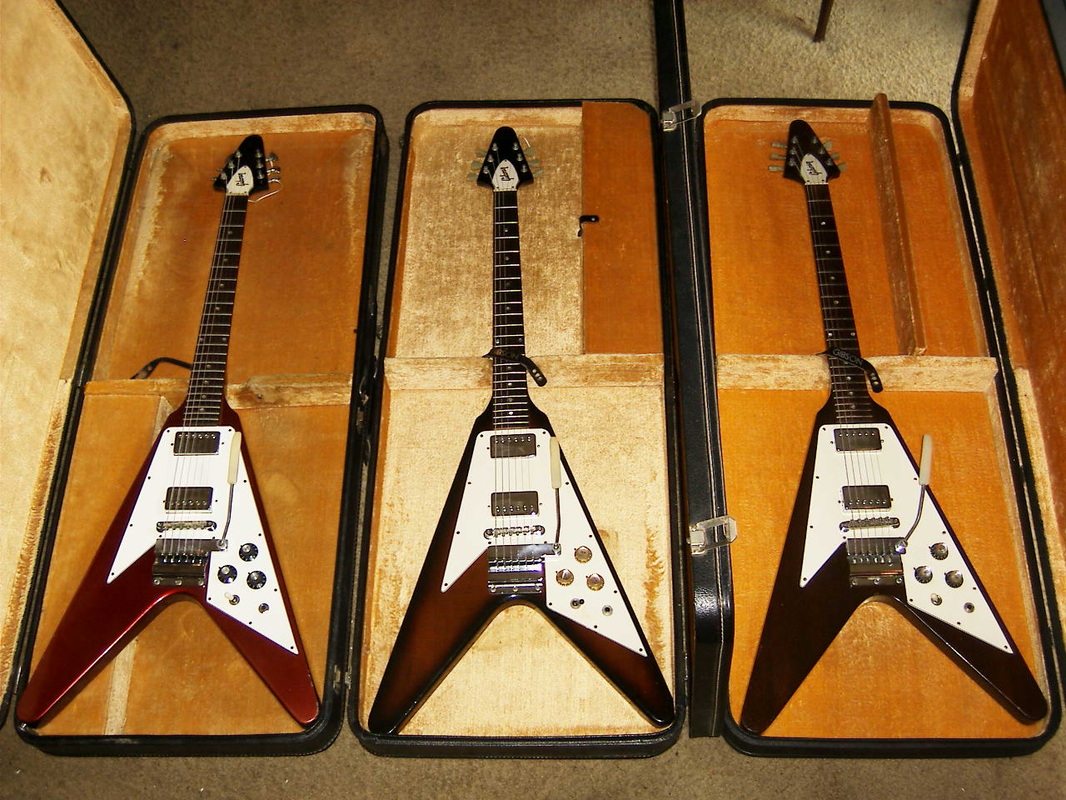
The original Korina Vs were only officially in production for two years, but Gibson reintroduced the model briefly in 1967 with a slightly different aesthetic design. These models are also significantly rare and seldom seen, and were all built out of the Mahogany rather than Korina, usually with either a cherry or sunburst finish.


Over the years, the Flying V has been associated with legendary guitarists who have helped define its legacy. Guitar virtuosos such as Jimi Hendrix and Albert King played a crucial role in popularizing the Flying V, showcasing its versatility across different genres. Lonnie Mack is another well-known V slinger, as well as Dave Davies of The Kinks. The guitar’s bold design and distinct sound also made it a favorite among many prominent musicians in the heavy metal scene of the 1980’s, including Dave Mustaine of Megadeth and Kirk Hammett of Metallica.

Despite its initial lukewarm reception and poor sales record in the late ’50s, the Flying V started to gain popularity in the 1960s and ’70s, becoming a symbol of rebellion and counter-culture. Its association with hard-hitting rock and metal further solidified its place in the pantheon of iconic guitars. In subsequent decades, Gibson has released various iterations of the Flying V, introducing modern or unique features while staying true to the guitar’s classic design shape.
The Flying V’s legacy lives on, and the guitar’s ability to transcend its functional purpose has made it an eye-catching cultural icon. Whether on stage or in the studio, the Flying V continues to inspire musicians to push the boundaries of their creativity, making it a timeless and cherished instrument in the world of electric guitars.
 IVG Blog